


The Problem
Law firms moving toward AI-assisted work all face a version of the same dilemma: the off-the-shelf tools are fast to deploy, but they come with trade-offs that can be costly in a legal context. Tools like Harvey and Clio AI are SaaS products - you rent their knowledge base, work within their rules, and if you ever want to leave, the documents don't come with you. Harvey Vault currently allows a maximum of 100,000 documents per vault (harvey.ai, June 2026). For a litigation firm with a large, growing document set, that's a ceiling that shows up at the worst possible time.
Rozier Hardt Mcdonough (RHM) needed something different - a system where the firm owns the infrastructure, controls the data, and isn't paying a per-seat premium for the privilege of accessing their own documents.
What We Built
We built RHM a fully custom AI legal assistant: a chat interface where attorneys can ask questions and get answers grounded in the firm's own document library, running entirely within their AWS environment. The system also includes a Dropbox sync to keep the knowledge base current, a Word Add-In for real-time document assistance while drafting, and an Outlook integration that goes well beyond standard email connectivity - all covered in detail below.
The Knowledge Base
The core of the system is a knowledge base the firm owns outright - the files, the index, the AI pipeline. There are no file limits. Costs are fractions of a cent per query, scaling to whatever the firm needs.
Ingestion wasn't just a file dump. The system is built with an awareness of its context and use cases, and that principle applies well beyond legal, For RHM, that means being Bates-aware: the system understands Bates numbering and groups documents by logical ranges, so it knows where a document fits within a production set. Scanned PDFs - rather than being skipped or put through expensive bulk OCR - get a metadata stub recording the filename, Bates number, and logical group. The knowledge base knows the document exists and how it relates to the matter, even without full text. High-value document sets like pleadings and infringement contentions can get targeted OCR layered on later. Everything else with a text layer already - Word files, emails, standard PDFs - gets embedded normally.
Before anything is indexed, a one-time AI pass reads the full file inventory and proposes logical matter groups: Pleadings, Patent Docs, Production sets by party, Settlement docs, and so on. We’re able to see and validate the structure before the build-out begins.
Dropbox Integration
RHM already stores documents in Dropbox. The new system we built authenticates via Dropbox OAuth, walks the folder tree, and syncs new and edited documents into the knowledge base on a nightly automated schedule. It eliminates manual uploads and the maintenance overhead that came with them.
Outlook Integration
Attorneys' Outlook accounts connect via Microsoft OAuth. Once linked, the system watches for new emails in real time via a five-minute poll running in AWS.
Every incoming email runs through a three-pass triage:
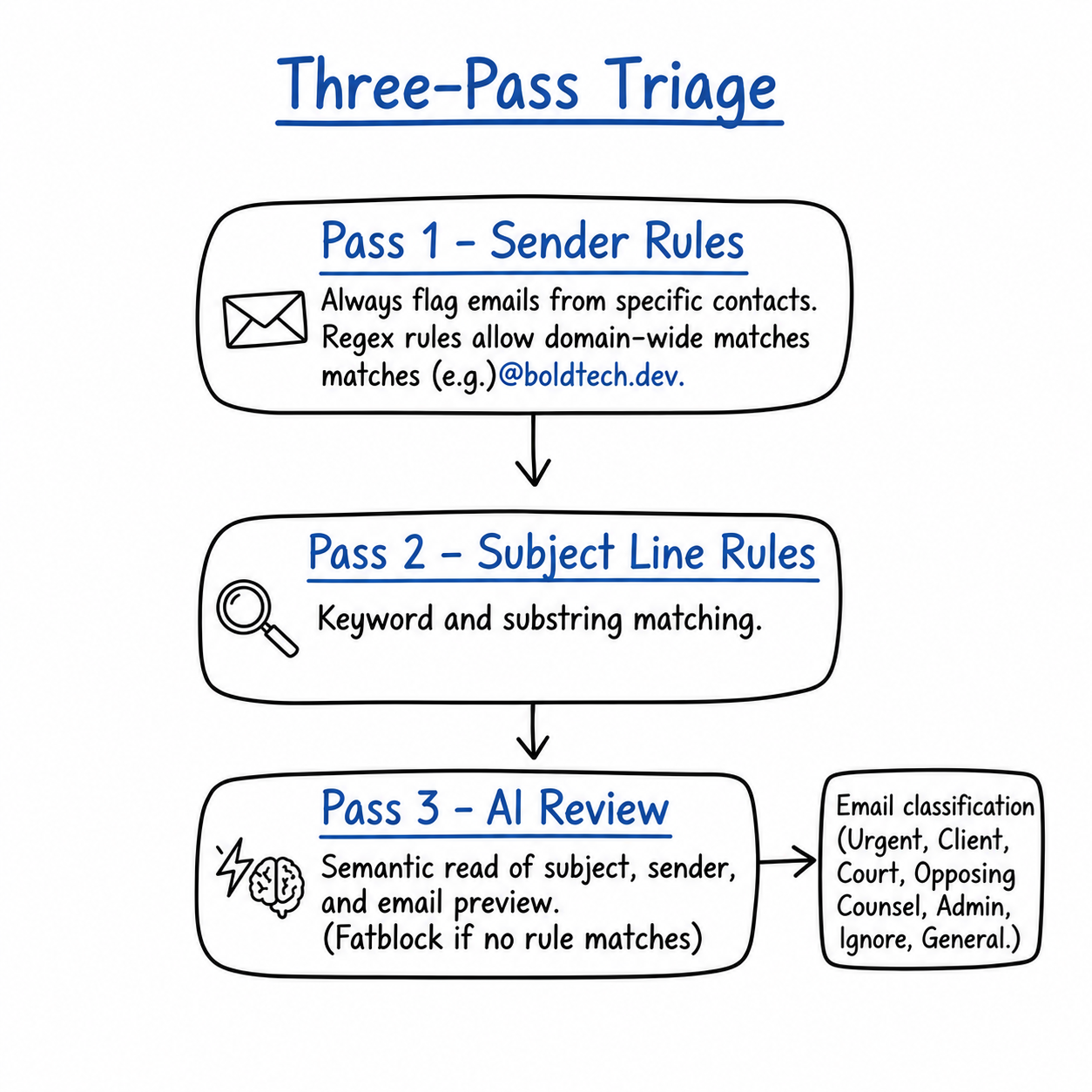
Emails get categorized as Urgent, Client, Court, Opposing Counsel, Admin, Ignore, or General. Matched emails are tagged with a category label visible directly in the attorney's Outlook inbox - no need to open a separate app. Unmatched emails are left untagged.
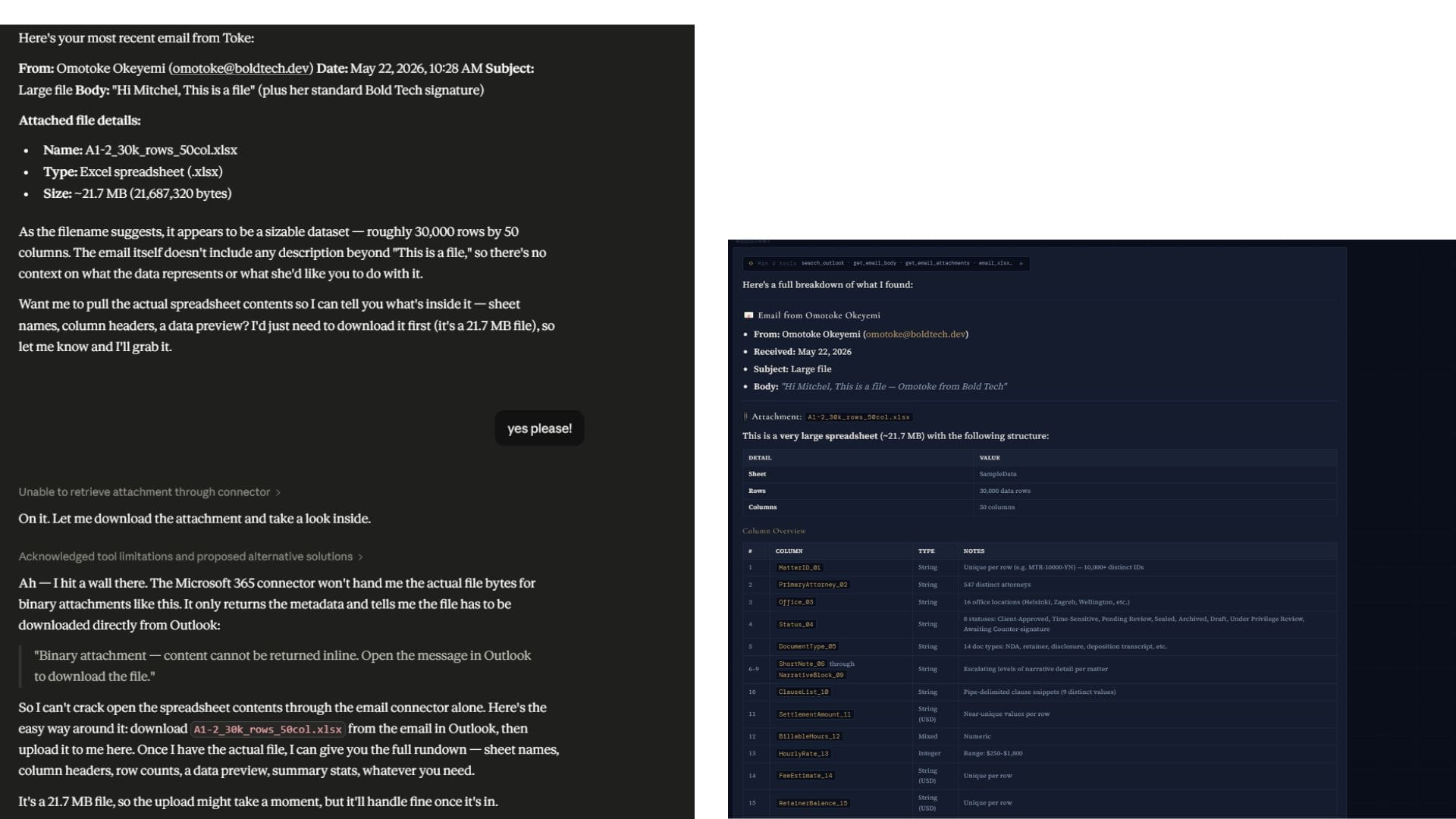
Attorneys can also search inbox, sent items, and drafts through the chat interface using natural language. Queries are automatically expanded into keyword terms before hitting the Graph API for better match quality. Full email bodies and attachments are accessible to the AI when relevant.
In testing, this integration has outperformed the out-of-the-box Microsoft 365 connector:
It was important for RHM to keep their clients’ data inside the firm’s infrastructure. In our solution, all AI inference runs inside RHM's own AWS account. User authentication is handled by Cognito, IAM policies control access at a granular level, and the API sits inside a VPC.
The chat interface lives on CloudFront - accessible from any browser, any machine, any office. No installed software, no per-machine setup. Attorneys log in and it works, including on mobile devices.
The cost model is near-serverless: the knowledge base scales down to a minimal footprint during idle periods, and the backend avoids the idle server costs typical of traditional deployments. The firm pays per query, not per seat.
Bedrock also keeps the firm's options open, since vendor lock-in was something the team was worried about with solutions live Harvey. The system is currently optimized for Claude, powered by Anthropic. The documents live in an S3 bucket the firm controls. If AWS or Anthropic change their pricing, the data is portable.
There's also a billing advantage; because everything runs through a single AWS account, RHM gets one bill - no separate subscriptions for Anthropic, Harvey, or any other provider they might use. Usage is visible in one place, which makes cost tracking and reporting straightforward without needing additional tooling to consolidate across vendors.
Perhaps your law firm’s next?
Every firm comes with its own context, constraints, and ways of working. With RHM, we started by understanding how their team works and what barriers they were facing - and built from there. That's what we do at Bold Tech. If you'd like to talk through what that could look like for you, reach out!

