


EdTech companies selling to businesses face a different challenge to those selling direct to learners. The customer is a corporate account - often with hundreds of seats, multiple departments, and a renewal conversation that starts months before the contract end date. The person responsible for that account needs to know, at any given moment, how engaged their learners are, which departments are underutilising their licences, where onboarding is stalling, and which accounts are quietly moving towards churn.
Most B2B EdTech teams are managing all of that across a CRM, a spreadsheet, and whatever their platform's admin dashboard happens to show. It works until it doesn't - and by the time an account looks like a renewal risk, the relationship has usually been slipping for a while.
Bold Tech designed this Retool template to demonstrate what a dedicated B2B client management tool can look like - account health, licence tracking, onboarding progress, and renewal pipeline in one place, with Claude providing the account intelligence that usually requires a manual report to surface. It's a starting point to build from, not a finished product. Every part of it can be shaped around your client structure, your success metrics, and how your team manages accounts.
Want to know a bit more about Retool? We've got plenty of resources on all things Retool: head to our blog, where we have Retool templates, tutorials and other resources, or check out our full What is Retool guide:
 Tools Team
Overview: a 360-degree view of every client account
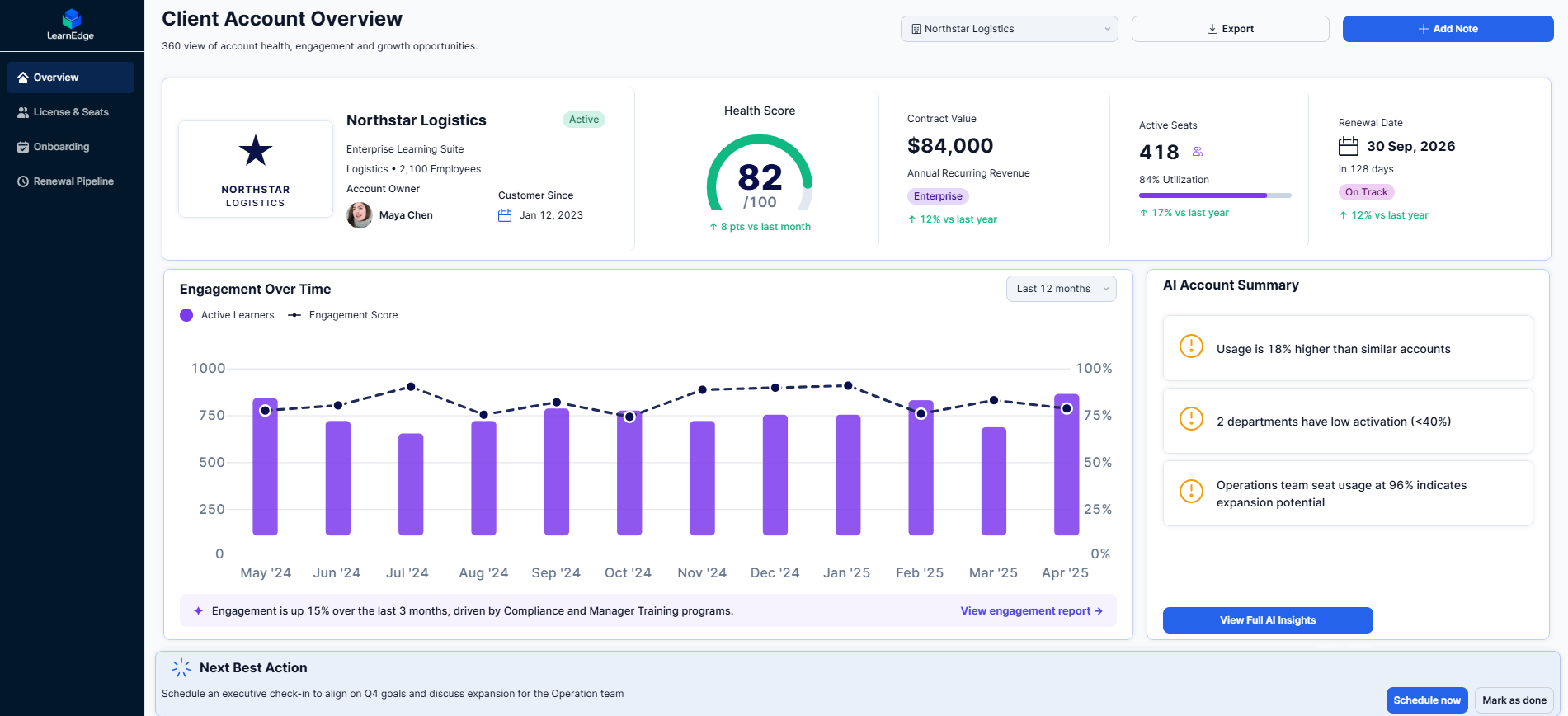
The Overview tab illustrates how an account manager might design a single view of everything that matters about a client. A header card shows the account name, plan, industry, size, account owner, and customer since date - alongside a health score, contract value, active seat count, utilisation rate, and renewal date, all in one place.
Below that, an Engagement Over Time chart tracks active learners and engagement score across the last 12 months, with an AI-generated insight at the bottom summarising what's driving the trend. An AI Account Summary panel on the right surfaces the three most important signals - departments with low activation, teams approaching capacity, usage compared to similar accounts - alongside a Next Best Action recommendation and a one-click button to act on it.
The right starting point when building this out is connecting it to your platform's engagement and usage data - that's what makes the AI insights genuinely useful rather than generic.
License & Seats: usage visibility down to department level
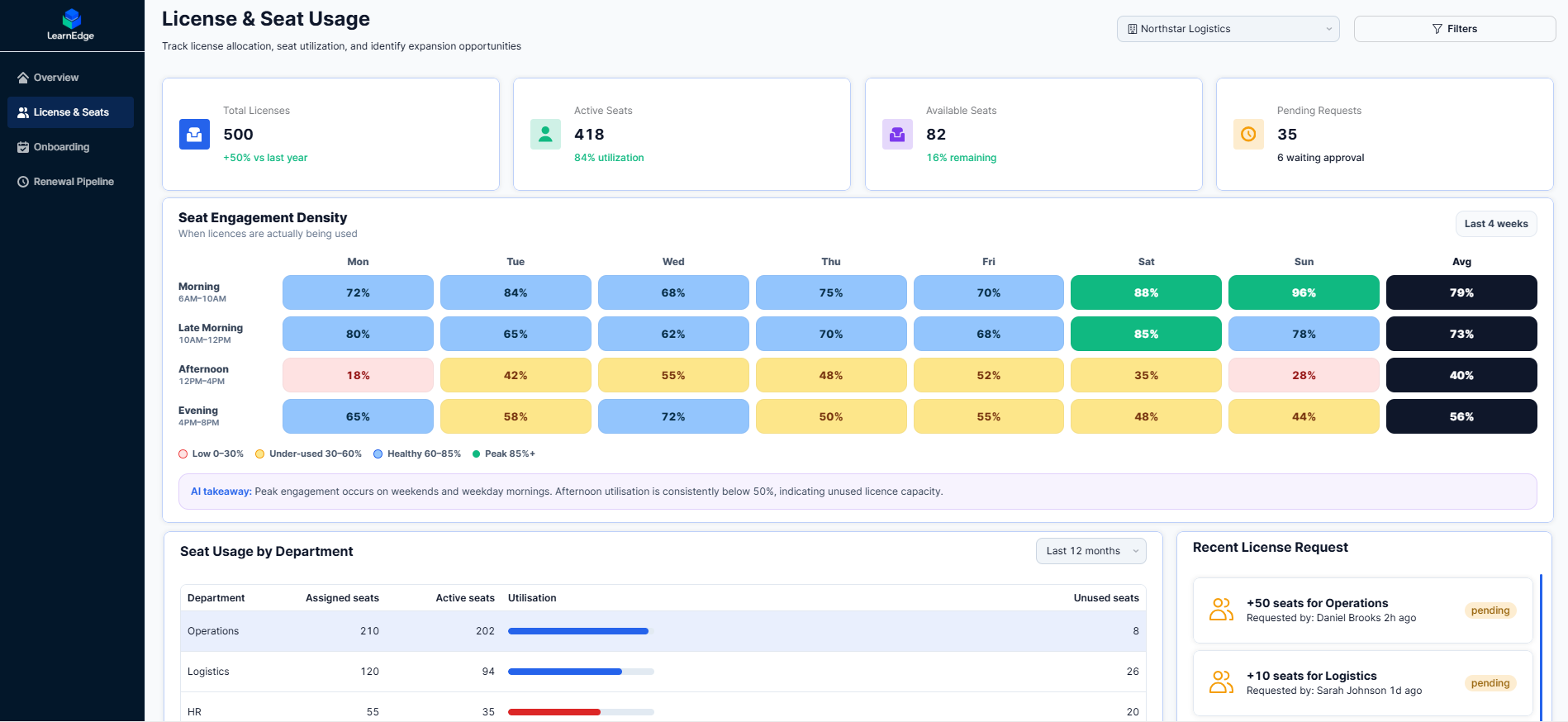
Licence underutilisation is one of the most common reasons B2B EdTech clients don't renew - and one of the easiest things to miss without the right visibility. This tab shows one way to design a clear view of how licences are actually being used across a client's organisation.
Four KPI cards show total licences, active seats, available seats, and pending requests. A Seat Engagement Density heatmap breaks down utilisation by day of the week and time of day, with an AI takeaway identifying when peak engagement occurs and where unused capacity sits. Below that, a department-level breakdown shows assigned seats, active seats, utilisation rate, and unused seats - making it immediately clear which teams are getting value and which need attention.
For account managers handling large enterprise clients, this level of visibility turns licence reviews from a reactive conversation into a proactive one - and opens the door to expansion discussions grounded in real usage data.
Onboarding: track activation progress across every client
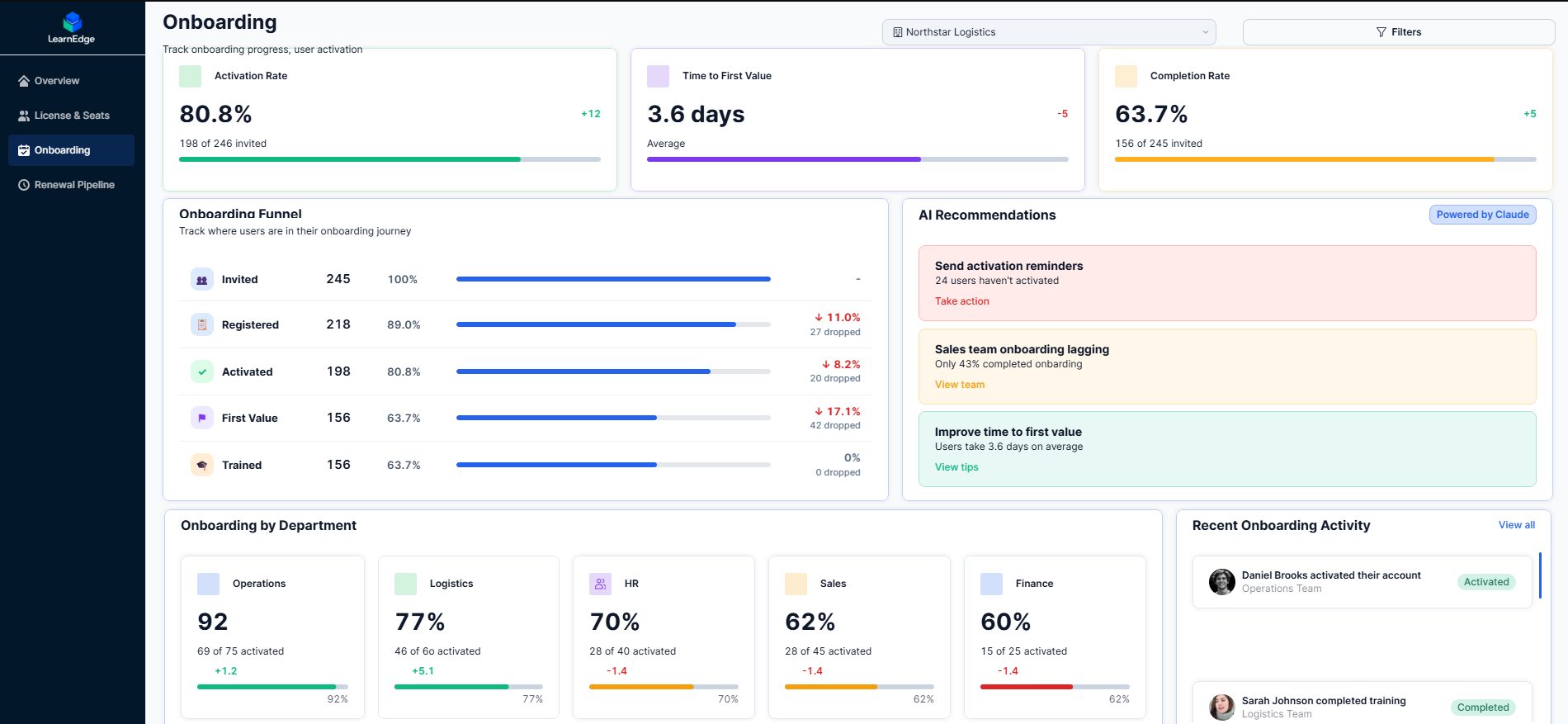
Slow onboarding is a churn risk that most B2B EdTech teams only notice in retrospect. This tab illustrates how a client success team might design a structured view of onboarding progress - not just whether users have logged in, but where they are in the full activation journey.
Three headline metrics show activation rate, time to first value, and completion rate. An Onboarding Funnel breaks down the full journey from invited through to trained, showing drop-off at each stage and flagging where users are getting stuck. An AI Recommendations panel - powered by Claude - surfaces the actions most likely to improve outcomes: sending activation reminders to users who haven't started, flagging departments that are lagging, and identifying where time to first value could be reduced.
A department-by-department breakdown below the funnel makes it easy to see which parts of the client's organisation are on track and which need a nudge - useful both for day-to-day account management and for renewal conversations where activation data tells the story.
- Education
- Healthcare
- Media
- eCommerce
- Logistics ops
- HR/Recruitment
and more! Sign up for our newsletter to ensure you're always getting access to our free resources.
Renewal Pipeline: every upcoming renewal visible, every risk flagged
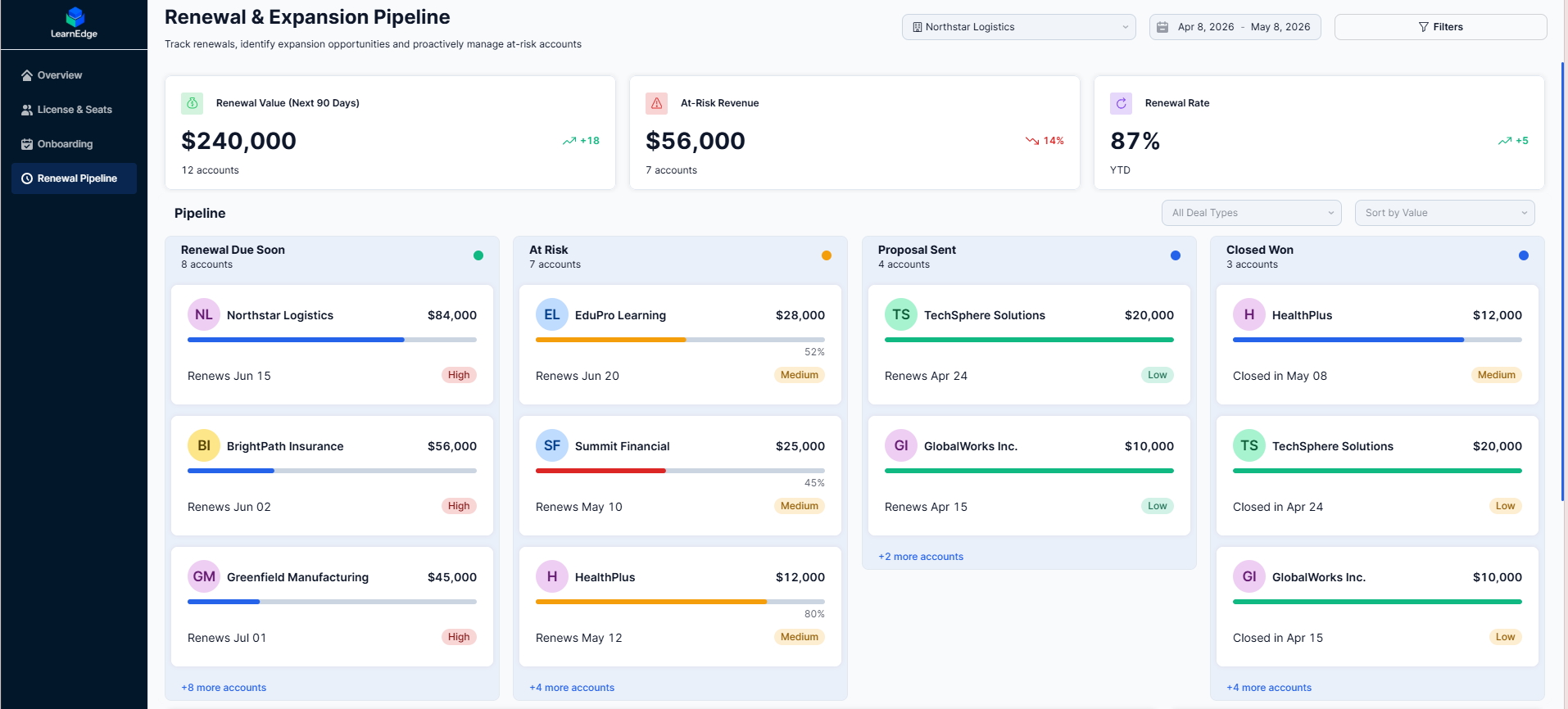
Renewal conversations that start too late are harder to win. This tab shows one way to design a pipeline view that keeps every upcoming renewal visible and prioritised, long before the contract end date arrives.
Three KPI cards show renewal value in the next 90 days, at-risk revenue, and YTD renewal rate. A kanban-style pipeline organises accounts by stage - renewal due soon, at risk, proposal sent, closed won - with each account card showing contract value, renewal date, and health status. The at-risk column makes it immediately clear which accounts need attention and how much revenue is at stake.
Depending on how your team manages renewals, this view could be extended to include expansion opportunities, multi-year deal tracking, or integration with your CRM so pipeline status stays in sync across both tools.
Download the template and get building ⬇️
B2B EdTech teams don't lose renewals because they aren't doing the work - they lose them because the signals that matter are buried across too many systems to act on in time. This template is a starting point for changing that: a practical blueprint that shows what a unified client management tool could look like, with AI doing the account intelligence so your team can focus on the relationships.
